

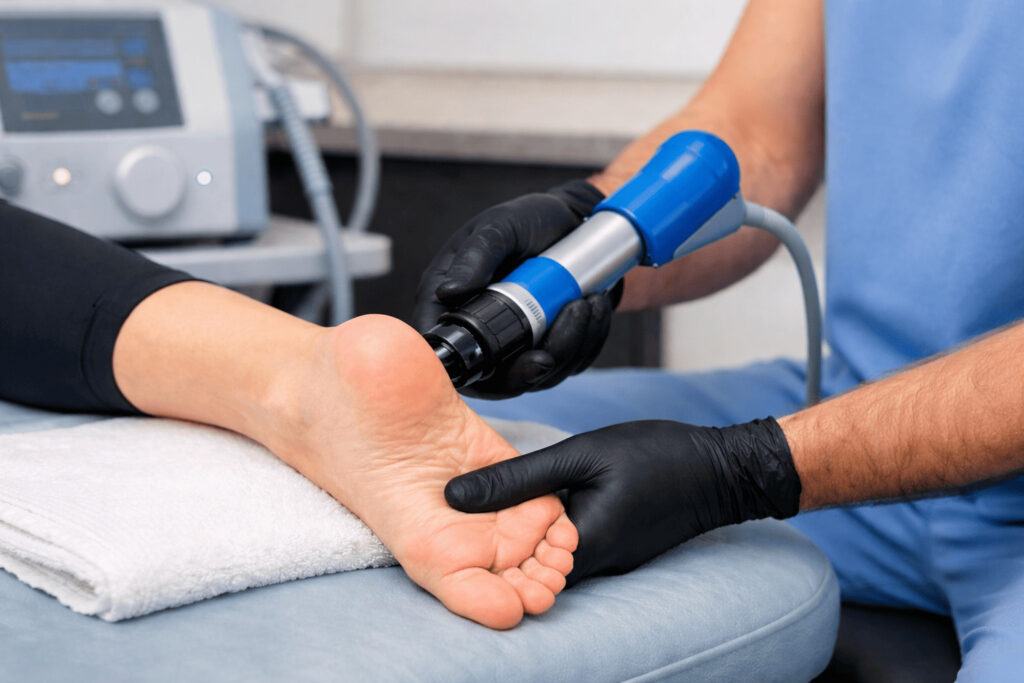
Shockwave therapy is often introduced as a treatment for chronic foot pain, particularly in cases that have not responded to more traditional approaches. That description is directionally accurate, but it does not fully explain why it works—or where it is most useful.
It is not a passive modality in the way it is sometimes presented. It is a mechanical stimulus applied to tissue that has failed to adapt appropriately to load.
The most common foot conditions treated by Shockwave Therapy are:
- Plantar Fasciitis
- Achilles Tendinopathy
- Morton’s Neuroma
- Neuropathy
- Other Nerve Related Pain
Shockwave for Plantar Fasciitis
Most of the foot conditions that respond well to shockwave therapy are not acute injuries. They are problems that have been present for a while and have not been managed effectively.
Plantar fasciitis is usually the first condition people associate with shockwave therapy, and for good reason.
A lot of these cases are not truly inflammatory. They are stubborn, chronic, and often sitting in that in-between space where nothing is acutely wrong, but nothing is improving either. People rest, stretch, roll their foot on a ball, and maybe feel some temporary relief—but the tissue never really changes.
What stands out with shockwave is that it gives you a way to actually stimulate a response in tissue that has stopped adapting. Instead of just trying to calm symptoms, you are creating an environment where the fascia can begin to tolerate load again.
You will often see a shift in how the pain behaves. It becomes less sharp, less limiting, and more predictable. That change is what allows someone to start moving normally again and actually progress.
Shockwave for Achilles Tendinopathy
A similar pattern is seen in Achilles tendinopathy.
This is one of the areas where shockwave stands out. In practice, the response in Achilles and heel-related tendon pain is consistently strong—strong enough that it changes how you think about treating these cases.
Patients will often come in with stiffness, pain with initial steps, or symptoms that have been lingering for months despite doing what they have been told to do. The tendon is not tolerating load the way it should.
When shockwave is introduced appropriately, it often creates a shift that is difficult to replicate with other interventions alone. Tissue that has been stuck in the same state for a long time begins to respond again. Pain decreases, tolerance improves, and the tendon becomes more adaptable to load.
That change does not replace the need for progressive loading—but it makes that process more effective. Without it, some of these cases simply do not move.
How long until Shockwave Therapy begins to work for foot conditions?
In many cases, there is also an early indication of whether shockwave is going to be helpful.
It is not universal, but when patients are going to respond well, it is common to see some degree of change even after the first session. That change may be subtle—less stiffness with the first few steps, slightly improved tolerance to pressure, or a shift in how the pain behaves—but it is usually noticeable.
From a clinical standpoint, that early response is encouraging. It suggests that the tissue is capable of adapting and that the stimulus is appropriate.
When there is no change at all over the first few sessions, it often prompts a reassessment—either of the diagnosis, the dosing, or how the area is being loaded.
For patients, this is useful context. If shockwave is going to be effective, there is often some signal early on that things are moving in the right direction.
Shockwave Therapy for Morton’s Neuroma
Morton’s neuroma presents differently, but there is often a similar underlying issue—chronic irritation in a region that is repeatedly compressed or overloaded.
While the mechanism is not identical to tendon or fascia-based conditions, shockwave can sometimes help reduce sensitivity and improve tolerance in the area. The goal is not to eliminate the structure, but to change how it responds to stress.
Shockwave for Neuropathy and nerve-related foot pain
Shockwave is also increasingly used in cases of neuropathy and nerve-related foot pain, which behave very differently from tendon or fascia-based conditions.
These cases are often frustrating. Symptoms like burning, tingling, numbness, or hypersensitivity can persist without a clear mechanical driver, and traditional approaches do not always lead to meaningful change.
The response here is different, but still important in the right presentation. Shockwave appears to influence the local environment around the nerve—circulation, signaling, and sensitivity—often leading to a reduction in baseline irritation.
Patients will frequently notice that the symptoms feel different before they fully improve. The irritation becomes less constant, less intense, and more manageable.
It is not a universal solution, and it requires consistency, but in cases that have not responded to other approaches, it can be a valuable addition.
Common Threads
Across all of these conditions, the common thread is not the diagnosis itself. It is the behavior of the tissue.
Tissue that is painful, poorly organized, and not tolerating load well tends to respond to the type of stimulus that shockwave provides. Tissue that is acutely injured or highly reactive tends not to respond in the same way.
This is why shockwave is typically more effective in chronic presentations than in recent injuries.
Shockwave therapy does not replace the need for appropriate loading, movement, and overall management. It changes the state of the tissue in a way that can make those interventions more effective.
If the underlying demands placed on the foot do not change, the same problem tends to return.
Conclusion
Clinically, it is best understood as a tool that helps restore a tissue’s ability to respond to stress.
When used in that context—and combined with a plan that addresses how the foot is actually being used—it can be highly effective in cases that have otherwise plateaued.
When used in isolation, its limitations become apparent. If you are dealing with foot health conditions and want to explore developing a treatment plan for your pain, schedule a free 20-minute phone consultation with Satriano Physiotherapy today!