

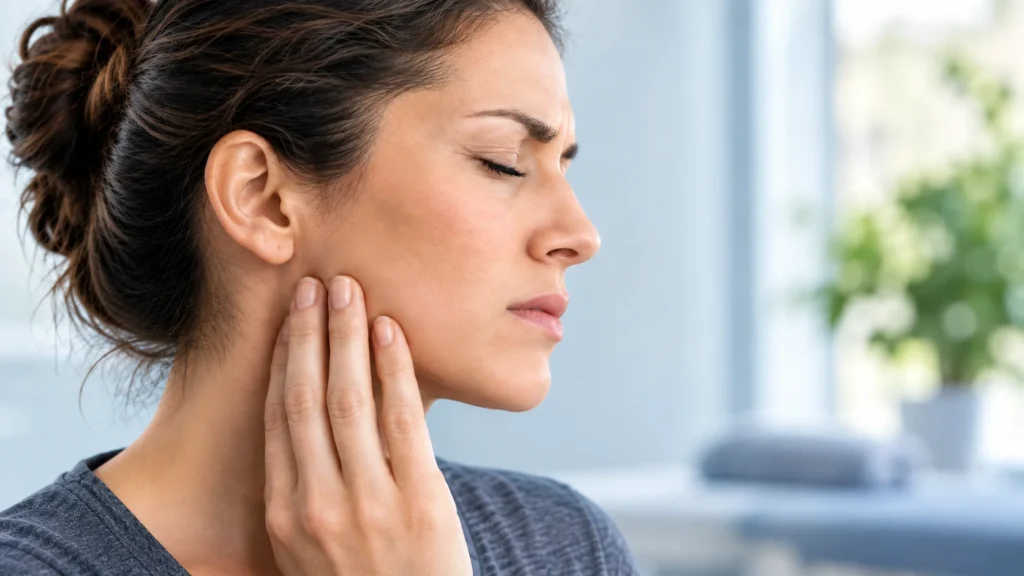
People often blame jaw pain, clicking, and a tight or tired jaw entirely on the joint, but the muscles that chew and stabilize the jaw are often the bigger contributor, and they respond to a very different kind of treatment than the joint. Myofascial trigger points in those muscles can create pain directly within the jaw or refer pain into the face, teeth, ear, temple, and head, which is exactly why so many people with jaw pain also carry a headache diagnosis, a tooth pain workup that came back normal, or an ear infection that was never actually there.
Key Takeaways
- Temporomandibular disorders (TMD) affect roughly 5% of adults, and muscle dysfunction, not just the joint itself, is a major contributor for many patients.
- Trigger points in jaw and chewing muscles can refer pain into the face, teeth, ear, temple, and head, which is why jaw problems often get misdiagnosed as dental or ear issues.
- The jaw and neck work as a connected system; dysfunction in one region regularly affects the other.
- Clenching, grinding, stress, posture, trauma, and prolonged dental work are common contributors worth identifying, not just treating around.
- The jaw is an anatomically sensitive area, so dosage and precision matter more here than in larger muscle groups.
Muscle Pain Or Joint Problem?
Temporomandibular disorders, often shortened to TMD or referred to as TMJ, describe a group of more than 30 conditions affecting the jaw joint and the muscles that control jaw movement, and they affect an estimated 5% of adults in the United States, more commonly women between 35 and 44.1 Some cases genuinely involve the joint itself: disc displacement, degenerative changes, or structural issues that need imaging and, sometimes, a dental or oral-surgery specialist.
But a large share of jaw pain has nothing to do with joint damage at all. It comes from the muscles responsible for chewing and stabilizing the jaw, the same way low back pain often comes from surrounding muscles rather than the spine itself. Those muscles can develop trigger points from overuse, clenching, or compensating for something else in the head and neck, and the pain they generate can feel exactly like a joint problem even when the joint is fine.
Which Muscles Refer Pain Into the Jaw, Face, and Head?
The muscles most often involved include the masseter along the cheek and jawline, the temporalis at the side of the head, and the deeper medial and lateral pterygoid muscles that control jaw movement from the inside. Each has its own referral pattern, and none of them announce themselves as the source the way a joint problem might.
| Muscle | Typical referral pattern | Often mistaken for |
|---|---|---|
| Masseter | Cheek, jawline, upper and lower teeth, sometimes the ear | A dental problem or TMJ joint issue |
| Temporalis | Side of the head, temple, sometimes behind the eye | Tension headache or migraine |
| Medial pterygoid | Deep inside the jaw, ear, throat | Ear infection or sinus problem |
| Lateral pterygoid | In front of the ear, jaw joint itself | The joint, rather than the muscle controlling it |
Effective treatment here requires three-dimensional thinking. It’s not simply about finding a trigger point, it’s about understanding how multiple muscles interact to produce jaw movement and pain, then treating that entire system with the appropriate technique and dosage. Needling one obviously tender spot and ignoring its neighbors usually means an incomplete result.
How Are the Jaw and Neck Connected?
The jaw doesn’t work in isolation. It sits at the end of a chain that includes the neck, the base of the skull, and the muscles that control head posture, and dysfunction in one region regularly influences the other. A patient who clenches at night often also carries tension through the upper trapezius and suboccipital muscles, and a patient with chronic neck tightness sometimes develops jaw compensation without ever realizing the two are connected.
This overlap comes up often enough with headache patients specifically that I’ve written about the neck-and-headache relationship separately. If a jaw evaluation turns up neck involvement, or vice versa, addressing only one side of that connection tends to leave part of the problem untouched. Read more in Dry Needling for Occipital Neuralgia, which covers several of the same muscles from a headache-first angle.
What Causes TMJ Dysfunction in the First Place?
Contributors I see regularly include clenching and grinding, often stress-related and often happening overnight without the patient realizing it; posture, particularly a forward-head position that changes how the jaw muscles have to work; a direct trauma like a blow to the jaw or a whiplash injury; and prolonged dental work that holds the jaw open in an unnatural position for an extended period. Rarely is it just one of these. Most patients I see have two or three factors stacking on top of each other.
The exam has to determine whether the muscles, the joint itself, the cervical spine, or some combination is actually involved, because the treatment plan changes significantly depending on the answer. A muscular problem responds to muscular treatment. A structural joint problem may need a different kind of care entirely, and part of a thorough evaluation is recognizing when that’s the case and referring appropriately.
What Does a Dry Needling Session for the Jaw Involve?
The jaw is a small, anatomically dense area, close to major nerves, blood vessels, and the joint itself, so precision and a conservative dosage matter more here than in a larger muscle like the glutes or quads. I use finer technique and typically less aggressive dosing in this region, watching closely for how a patient responds before progressing.
Most patients tolerate jaw needling well, though the masseter and temporalis can feel more sensitive than expected given how often they’re used throughout the day. As with anywhere else in the body, needling here is paired with addressing the contributing factors, whether that’s a posture correction, stress management, or coordination with a dentist about a night guard, rather than treating the muscles in isolation and hoping the clenching habit resolves on its own.
Frequently Asked Questions
Is TMJ pain always a joint problem?
No. A significant portion of jaw pain comes from the muscles responsible for chewing and jaw stability, not from damage or dysfunction within the joint itself. An exam is the only reliable way to tell which is driving a specific case.
Can jaw pain really cause headaches or tooth pain?
Yes. Trigger points in jaw muscles commonly refer pain into the face, teeth, ear, temple, and head, which is why jaw-related pain is sometimes mistaken for a dental problem, an ear infection, or a headache disorder with a completely different cause.
Does dry needling for the jaw hurt more than other areas?
The jaw muscles can feel more sensitive than larger muscle groups, so I typically use a more conservative dosage and finer technique here than I would for the low back or hip.
Should I see a dentist or a physical therapist for jaw pain?
It depends on what’s driving it. If the exam points toward muscular dysfunction, physical therapy and dry needling are appropriate. If imaging or exam findings suggest a structural joint problem, a dentist, oral surgeon, or TMJ specialist should be involved, sometimes alongside physical therapy rather than instead of it.
Can stress really cause jaw pain?
It’s one of the most common contributors I see, usually through nighttime clenching or grinding the patient isn’t fully aware of. Addressing the muscular tension helps, but identifying and managing the underlying stress or habit tends to make results last longer.
How many sessions does it typically take?
It varies by how long the pattern has been present and how many contributing factors are involved, but many patients notice a change in muscle tension and jaw comfort within the first few sessions, with the full plan built around what the exam finds.
Where This Leaves You
Jaw pain that’s been chalked up entirely to “TMJ” without anyone examining the surrounding muscles is missing a significant part of the picture. If pressing on the right muscle reproduces the exact pain a patient has been living with in their jaw, face, or head, that’s a clear place to start, and often a faster path to relief than another round of imaging focused only on the joint.
Every new patient at Satriano Physiotherapy begins with a 90-minute evaluation, which gives enough time to properly separate a muscular jaw problem from a joint problem before any treatment begins. If you’re in the Baltimore area and want to find out what’s actually driving your jaw pain, we offer a free 20-minute consultation to start that conversation.