

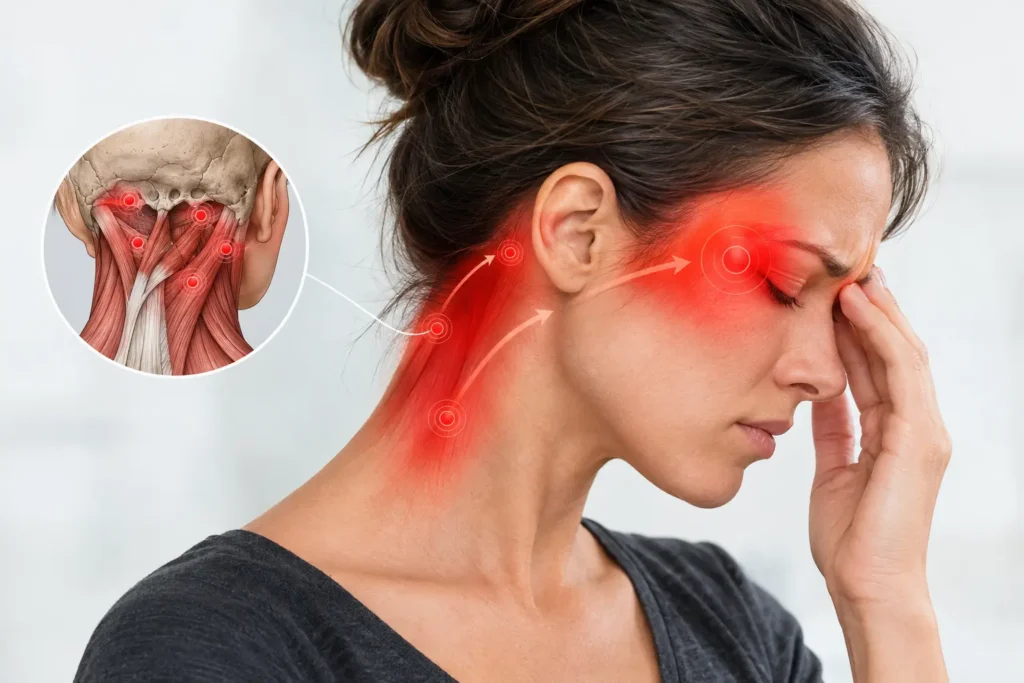
A headache behind the eye that started at the base of your skull is often coming from a handful of specific neck muscles, not from a nerve problem in isolation, and finding which muscle reproduces your exact pain pattern is usually the fastest way to real relief. When I examine patients with this pattern, I can often reproduce their familiar headache by pressing on or needling a muscle in the neck, and the pain travels up the back of the skull and settles directly behind the eye, exactly where they feel it every time.
Key Takeaways
- Occipital neuralgia, cervicogenic headache, and migraine overlap often enough that the diagnosis on paper doesn’t always explain everything driving the pain.
- A short list of neck and jaw muscles (sternocleidomastoid, upper trapezius, suboccipitals, obliquus capitis inferior) can reproduce the exact headache pattern a patient recognizes.
- One patient went from about 15 migraines a month to one or two after two dry needling treatments; that’s an exceptional result, not a promise for every patient.
- Dry needling reaches deeper suboccipital tissue that’s hard to address thoroughly with manual therapy alone, and hypermobile patients often need a specific plan for what comes after.
- New, severe, or neurologically unusual symptoms always warrant medical evaluation; not every headache is muscular.
Is It Occipital Neuralgia, a Migraine, or Both?
Often both, or a diagnosis that doesn’t tell the full story. Many patients arrive with a diagnosis of occipital neuralgia, migraine, or both, describing burning, stabbing, or aching near the base of the skull that travels up and forward toward the temple or behind the eye.
Occipital neuralgia has become an increasingly common diagnosis, and I’m not questioning any neurologist’s evaluation. There are certainly patients whose occipital nerves are genuinely involved. The diagnosis just doesn’t always capture everything contributing to the symptoms.
The upper neck holds several small muscles beneath the base of the skull, plus larger muscles connecting the head and neck to the shoulder girdle. These tissues share close anatomical and neurological relationships with the areas where patients feel their headaches, and the jaw and the muscles along the front and side of the neck often join the same pattern. That’s why I don’t treat every patient with pain at the back of the head by needling the one spot that hurts.
Which Neck Muscles Actually Reproduce This Headache?
Four muscles come up again and again: the sternocleidomastoid along the front and side of the neck, the upper trapezius, the suboccipital group beneath the skull, and a deeper muscle called the obliquus capitis inferior. There are eight small suboccipital muscles in total, and they carry an unusually high concentration of sensory receptors, which helps explain how much pain they can generate when irritated.
| Structure | Typical pain pattern | Often overlooked because |
|---|---|---|
| Suboccipitals | Deep ache at the base of the skull, spreading upward | Small and deep, easy to under-treat with hands alone |
| Sternocleidomastoid | Refers toward the head and around the eye | Front-of-neck muscle, not where the headache is felt |
| Upper trapezius | Neck and headache pain together | Blamed for “tension” without a specific trigger point exam |
| Obliquus capitis inferior | Deep, often surprising referral behind the eye | Rarely examined outside specialty dry needling training |
The suboccipitals don’t work alone. The splenius muscles, cervical multifidus, scalenes, jaw muscles, shoulder blade region, breathing mechanics, and general posture can all deserve consideration depending on the patient. Someone who spends the day at a computer, clenches their jaw, has limited upper back movement, or is naturally hypermobile can carry the same diagnosis as someone else and still need a very different treatment plan.
What Happened When One Patient Went From 15 Migraines a Month to One or Two?
She arrived with diagnoses of both occipital neuralgia and migraine, roughly 15 migraines a month, and significant pain behind the eye. She was also hypermobile, which mattered when I decided how to treat her neck and what needed to happen afterward so the extra mobility didn’t become a liability.
During the exam, I reproduced her familiar headache from several areas: the sternocleidomastoid, upper trapezius, suboccipital region, and obliquus capitis inferior. Her jaw was part of the picture too. Reproducing someone’s headache isn’t the goal by itself. It confirms the area being examined is actually connected to the pain the patient recognizes, not just tender in an unrelated spot, and patients will often say immediately, “That’s my headache,” as the sensation travels toward the head.
After two treatments, her headache frequency dropped from about 15 migraines a month to one or two, and the ones that remained were less intense. Her neck movement improved right away. That’s an exceptional response and not one I’d promise every patient, but it shows how much the muscular system can contribute even after a neurological diagnosis is already on the chart.
What Does Dry Needling Add That Manual Therapy Alone Doesn’t?
Manual suboccipital release helps, and I use it often, but dry needling reaches specific tissues, including some of the deeper muscles, that can be hard to address thoroughly with hands alone. Patients often recognize their headache pattern during treatment, followed by a real change in pressure, pain, or neck movement.
Because the upper cervical region is anatomically sensitive, treating it requires precise knowledge of the muscles, nerves, blood vessels, and correct needle direction and depth. I’ve taught these specific techniques to other dry-needling practitioners for years, first through Myopain Seminars and now through my own continuing-education program, Applied Myofascial Sciences, and this isn’t an area for vague anatomy.
Some people tolerate needling very well, and others need to start with manual therapy or a more gradual approach. Once motion improves, I add strengthening and stability work, particularly for a hypermobile patient, so the neck can control its new range instead of simply tightening back up.
Is There a Gentler Option If I’m Not Ready for Needling?
Yes. For patients who can’t yet tolerate more active treatment, often the case with significant nerve sensitivity or a very reactive nervous system, I sometimes start with a gentler approach like craniosacral therapy to help calm an overactive system down before progressing to dry needling. It’s a way to make progress without asking an irritated nervous system to tolerate more than it’s ready for on day one.
Frequently Asked Questions
Can occipital neuralgia and migraine really happen at the same time?
Yes, and it’s common. Many patients carry both diagnoses, and the muscular contribution from the neck and jaw can affect either pattern regardless of which label a neurologist used first.
How many dry needling sessions does it typically take to notice a change?
Some patients notice a difference within one or two sessions, though everyone’s neck, nervous system, and history are different, so the timeline isn’t identical for everyone.
Does dry needling for a headache like this hurt more than needling elsewhere?
The suboccipital region can be more sensitive than larger muscle groups, so I’m typically more conservative with depth and dosage there than in, say, the low back or hip.
Is dry needling safe for someone who is hypermobile?
It can be, but the plan afterward matters as much as the treatment itself. Hypermobile patients generally need a stability and strengthening program layered in once mobility improves, so the neck doesn’t simply loosen without learning to control that new range.
What’s the actual difference between a cervicogenic headache and occipital neuralgia?
A cervicogenic headache is pain referred from the neck’s joints and muscles, while occipital neuralgia specifically involves irritation of the occipital nerves themselves. In practice, the two overlap enough in how they feel that a thorough muscular exam is usually worthwhile regardless of which term is on the chart.
When should I see a doctor instead of starting dry needling?
New, severe, or neurologically unusual symptoms, such as sudden onset, vision changes, weakness, or a headache unlike any you’ve had before, need medical evaluation first. Dry needling is not a substitute for ruling out a more serious cause.
Where This Leaves You
Not every headache is muscular, and the National Institute of Neurological Disorders and Stroke notes that occipital neuralgia itself is a distinct nerve condition that sometimes needs its own targeted care. But for the right patient, an occipital neuralgia or migraine diagnosis doesn’t mean the neck, jaw, and surrounding muscles should be ignored. Sometimes the most useful moment in an exam is when I treat a muscle in the neck and the patient says immediately, “That’s exactly where my headache goes.” That connection gives us a clear place to start.
Every new patient at Satriano Physiotherapy begins with a 90-minute evaluation, because a headache pattern like this deserves more than a quick look at the spot that hurts. If you’re in the Baltimore area and want to find out whether your headache is coming from your neck, we offer a free 20-minute consultation to start that conversation.