Living with Ehlers-Danlos syndrome (EDS) can involve more than hypermobile joints. Some people also develop persistent pain around the Achilles, elbow, shoulder, knee, hip, or plantar fascia. Joint instability, altered movement patterns, muscle compensation, and difficulty handling repetitive loads can all contribute. Importantly, pain near a tendon does not automatically mean the tendon itself is damaged, which is why an individualized evaluation matters so much.
One treatment that has drawn attention for stubborn tendon pain is shockwave therapy. Research suggests it may reduce pain and improve function for some tendinopathies, though results depend heavily on the condition and the individual. Whether it is right for someone with EDS depends on far more than the diagnosis.
At Satriano Physiotherapy in Baltimore, shockwave therapy is one of several tools Dr. Rob Satriano may draw on, alongside dry needling, manual therapy, and craniosacral therapy. Which tool is used, if any, always follows the evaluation.
| The treatment always follows the diagnosis, not the other way around. — Dr. Rob Satriano |
Why Tendon Pain Is Common in EDS
Ehlers-Danlos syndrome affects collagen, which gives tendons and ligaments their strength. When collagen is affected, connective tissue becomes more elastic and less able to support normal movement, so muscles and tendons must work harder to stabilize the joints during everyday activity. Even simple tasks, climbing stairs, carrying groceries, typing, or walking for a while, can place repeated stress on tendons.
Over time, repeated or poorly tolerated loading can contribute to persistent tendon pain. These symptoms often build gradually and tend to linger when the joint instability, movement pattern, or activity demands behind them are not addressed. This is the key question Dr. Satriano works to answer: not just where it hurts, but why that tissue became overloaded in the first place.
Understanding Shockwave Therapy
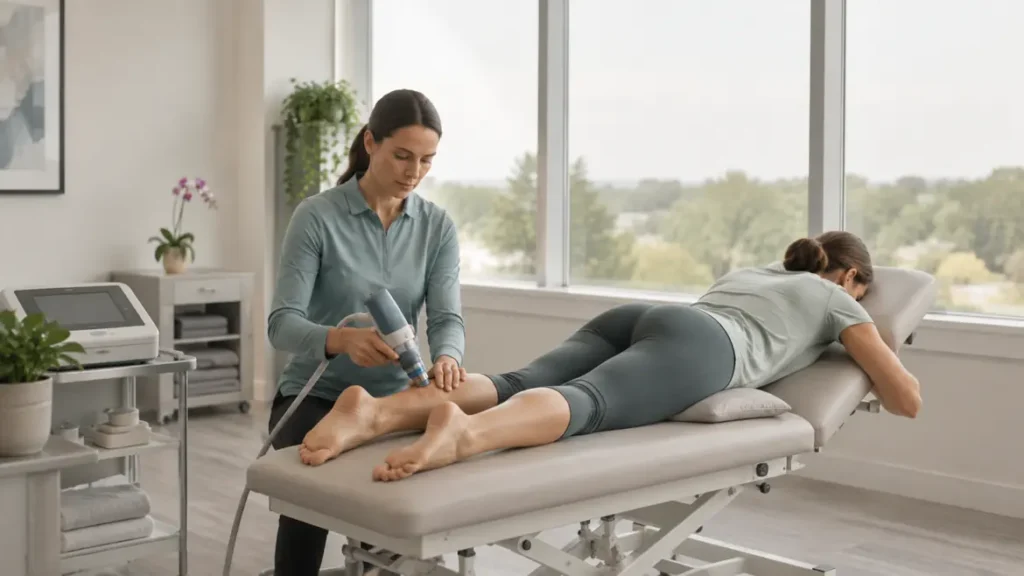
Shockwave therapy, sometimes called extracorporeal shockwave therapy or EPAT, is a noninvasive treatment that delivers acoustic pressure waves to a targeted area. It is used for certain persistent musculoskeletal conditions, including some forms of tendinopathy and plantar heel pain.
Researchers are still studying exactly how it works. Proposed effects include changes in pain signaling and stimulation of the biological processes involved in tissue remodeling. It is more accurate to say shockwave therapy may support recovery in appropriately selected conditions than to claim it regenerates or heals tissue. Intensity and duration vary by device, condition, and tolerance, and because some people feel temporary soreness afterward, the response is monitored before intensity is increased.
How Shockwave Therapy Fits Into Treatment
Dr. Satriano views shockwave therapy as a potential tool within rehabilitation rather than a stand-alone fix. If it reduces pain or makes loading more tolerable, that improvement creates an opportunity, a window, to progress strengthening and movement retraining. The long-term goal is always to improve the body’s ability to manage the forces placed on the affected area, not simply to quiet the symptom for a while.
Is Shockwave Therapy Safe for People with EDS?
For many people with EDS, shockwave therapy can be safely incorporated into rehabilitation when it is performed by a clinician familiar with hypermobility disorders. But because EDS affects connective tissue throughout the body, treatment must be individualized. Patients with EDS often have heightened tissue sensitivity, joint instability, and varying pain tolerance, and some have related conditions such as dysautonomia or POTS that affect how they respond. Intensity, frequency, and the area treated all need to be adjusted to the individual rather than borrowed from a standard orthopedic protocol.
Conditions That May Benefit From Shockwave Therapy
Shockwave therapy has been used for conditions such as Achilles tendinopathy, patellar tendinopathy, lateral elbow tendinopathy, certain rotator cuff conditions, gluteal tendon pain at the hip, and plantar heel pain. Evidence and expected outcomes differ between them, and a diagnosis alone does not make someone a good candidate. Dr. Satriano evaluates whether the symptoms appear to originate from the tendon or the surrounding tissue, whether the problem has become persistent, and whether the patient can take part in the exercise and movement side of rehabilitation.
Why Strength Training Still Matters
One of the biggest drivers of tendon pain in EDS is the constant demand placed on muscles and tendons to stabilize loose joints. Progressive strengthening spreads those forces more evenly and improves joint control, so tendons absorb less excessive stress during movement. As with everything in EDS, strengthening is progressed gradually; too much too soon can worsen symptoms rather than improve them. Shockwave therapy, when appropriate, is used to make that strengthening work possible, not to replace it.
When Shockwave Therapy May Not Be Recommended
Shockwave therapy is not right for every patient or every type of pain. Certain medical conditions, acute injuries, fractures, or infections may make other treatments more appropriate. In some cases, what looks like tendon pain is actually driven by joint instability or muscle dysfunction rather than tendon degeneration. This is exactly why a comprehensive evaluation comes first: identifying the true source of pain is what allows treatment to address the problem instead of chasing the symptom.
Find Specialized EDS Care in Baltimore
Chronic tendon pain with EDS can be frustrating, but you do not have to navigate it alone. With the right combination of individualized physiotherapy, progressive strengthening, movement retraining, and advanced tools like shockwave therapy when appropriate, many people experience meaningful improvements in pain and function.
If you are dealing with chronic tendon pain related to Ehlers-Danlos syndrome or joint hypermobility, schedule an evaluation with Satriano Physiotherapy to learn whether shockwave therapy may be an appropriate part of your personalized rehabilitation program.
| About Dr. Rob Satriano: Dr. Rob Satriano, PT, DPT, is a Doctor of Physical Therapy in Lutherville, Maryland, serving the greater Baltimore area. He taught dry needling to physical therapists, physicians, and other healthcare providers for more than eight years through Myopain Seminars, and trained directly under Jan Dommerholt, one of the world’s leading researchers in trigger point dry needling and myofascial pain. He has worked with professional and tactical athletes, including Washington Commanders players, and regularly treats complex cases referred by other clinicians. Dr. Satriano also lives with hypermobility and has lived with chronic pain and has recovered from multiple hip surgeries, experience that shapes how he evaluates and cares for every patient. Learn more about Dr. Satriano. |