

Finding out you have a hip labral tear can be concerning, especially when you’ve been dealing
with persistent hip pain and an MRI finally seems to provide an explanation.
But finding a tear on an MRI doesn’t necessarily mean it’s responsible for your symptoms. And
even when the labrum is contributing to your pain, surgery isn’t always necessary.
I’ve treated patients with hip labral injuries for years, and I’ve also undergone labral surgeries on
both of my own hips. My experience as both a physical therapist and a patient has significantly
influenced how I evaluate these injuries and approach rehabilitation.
What Is a Hip Labral Tear?
The labrum is a ring of fibrocartilage surrounding the socket of the hip joint. It helps stabilize the
hip, maintain a seal around the femoral head, and distribute forces across the joint.
Labral tears can occur following an injury, repetitive loading, or changes in hip anatomy,
including femoroacetabular impingement (FAI).
Symptoms can include deep groin pain, catching, clicking, or discomfort with movements such
as squatting, sitting, and bringing the knee toward the chest. Some patients experience pain
around the outside or back of the hip as well.
It’s also possible to have a labral tear without experiencing any symptoms.
A labral tear is only one piece of the clinical picture. Understanding whether it’s actually
contributing to someone’s pain requires looking at their symptoms, movement, and the
surrounding muscles—not just the MRI.
Does a Labral Tear on an MRI Mean It’s Causing Your
Pain?
Not necessarily. When a patient comes to me with an MRI showing a labral tear, one of the first things I want to
know is whether they have an earlier MRI of that same hip to compare with the current
MRI. If the tear was already visible several years earlier, particularly when the patient wasn’t
experiencing the same symptoms, that’s important clinical information. It suggests the tear may
have been present long before their current pain developed.
Unfortunately, most patients don’t have an earlier MRI because there was no reason to image the
hip before they developed symptoms. From there, I’m interested in the quality of their pain and what specifically reproduces it.
Is it deep in the groin? Does it feel sharp or aching? Is there a catching or locking sensation?
Does it occur during deep hip flexion or internal rotation?
For example, a patient with an anterior-superior labral tear who describes sharp catching during
deep hip flexion may be experiencing mechanical irritation from the torn labrum. That possibility
deserves consideration, although the symptoms alone don’t confirm it. I also examine the surrounding musculature because muscular pain can coexist with a labral
injury or produce similar symptoms.
The Muscular Component of Hip Pain
One of the things I evaluate closely in patients with labral injuries is the contribution of the
surrounding muscles and connective tissues.
The hip is surrounded by structures that can produce pain independently of the labrum or
contribute to symptoms occurring alongside a labral injury.
I’m particularly interested in the iliopsoas, iliacus, proximal rectus femoris, pectineus, abdominal
muscles, and gluteal musculature.
These structures influence hip movement, pelvic control, and how forces are distributed around
the joint. When they’re painful, sensitive, or not functioning well together, they can contribute
significantly to anterior hip discomfort.
I’ve treated patients whose symptoms initially appeared consistent with a labral injury but who
also had substantial myofascial involvement.
Addressing those muscular contributors can sometimes change a patient’s pain considerably,
even though the structural labral finding remains unchanged.
This is also personal for me.
Having undergone labral surgeries on both hips, I often wonder whether access to better
myofascial treatment, including skilled dry needling, might have changed my own treatment
decisions.
At the time, I didn’t fully understand how much the surrounding musculature could contribute to
the symptoms I was experiencing.
I can’t know whether that treatment would have prevented either surgery, but my experience has
made me much more attentive to these structures when evaluating patients with similar injuries.
Can Dry Needling Help With a Hip Labral Tear?
Dry needling doesn’t repair a torn labrum.
However, when muscular pain, guarding, or movement restrictions are contributing to someone’s
symptoms, dry needling may be useful as part of a comprehensive rehabilitation program.
In my practice, I assess the muscles surrounding the hip to determine whether specific
myofascial structures are contributing to the patient’s pain.
Treatment may include dry needling, manual therapy, and exercises designed to improve
muscular coordination and reduce irritation around the joint.
The important question isn’t simply whether a patient has a labral tear. It’s whether we can
identify and treat contributing sources of pain and improve their function.
If someone’s symptoms improve substantially with conservative treatment, that may influence
whether surgical intervention is necessary.
Where Hip Rehabilitation Can Go Wrong
One issue I encounter frequently, particularly with patients recovering from labral surgery, is the
progression of resisted hip flexion exercises before they’ve established adequate strength and
control elsewhere.
Exercises such as straight-leg raises and resisted hip flexion can place considerable demands on
the iliopsoas and rectus femoris. When these exercises are introduced too aggressively, particularly in patients who already have anterior hip irritation, they can perpetuate discomfort and make rehabilitation more difficult.
I prefer to establish a foundation of abdominal strength, pelvic control, and gluteal and posterior-
chain activation before progressing to more demanding hip flexor strengthening.
That doesn’t mean avoiding hip flexion or neglecting the hip flexors. It means being thoughtful
about when and how those muscles are loaded.
I also pay attention to how patients control their pelvis and trunk when moving into hip flexion.
Poor coordination can lead patients to rely excessively on already irritated structures.
My approach has been influenced by the rehabilitation protocols associated with Dr. Marc
Philippon and the Steadman Clinic, as well as my own experiences undergoing labral surgery
and working through postoperative rehabilitation. Restoring hip motion and strength is important, but more aggressive exercise isn’t necessarily better exercise.
What Does Physical Therapy for a Hip Labral Tear Involve?
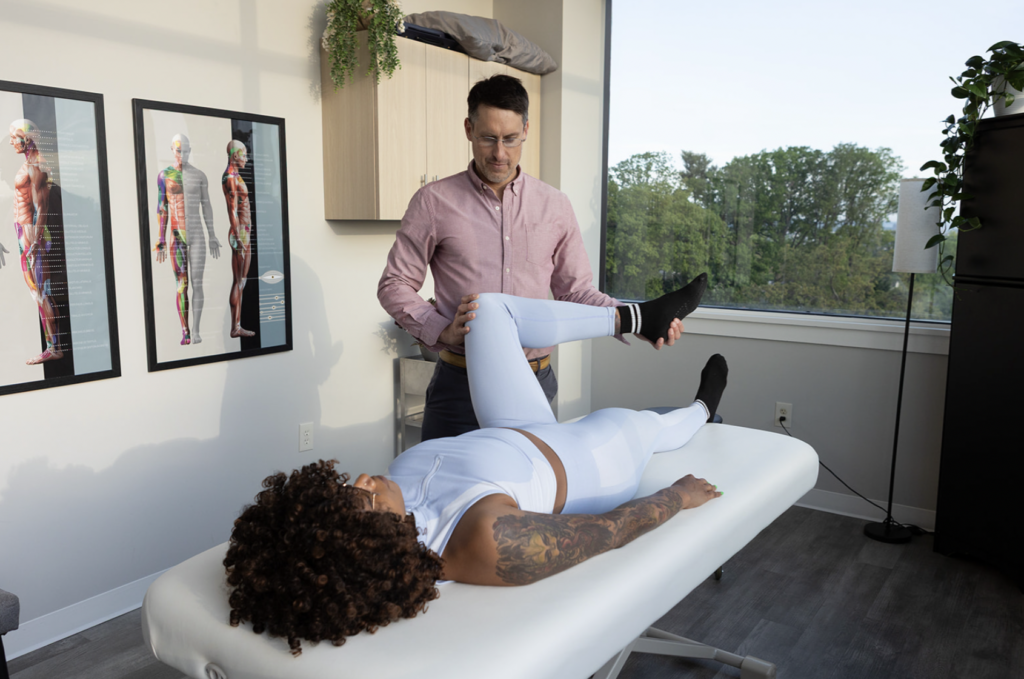
Treatment begins with understanding which movements reproduce the patient’s symptoms and
identifying the factors contributing to those symptoms.
I assess hip mobility, strength, muscular sensitivity, and the patient’s ability to control movement
through the pelvis and trunk.
Hip flexion and internal rotation are often particularly informative, especially when those
movements reproduce familiar pain or catching.
If deep hip flexion is irritating, repeatedly forcing that movement may only aggravate symptoms.
Instead, we may begin by addressing muscular pain and irritation while developing better
abdominal control, gluteal strength, and posterior-chain coordination.
As the patient improves, we gradually introduce more demanding strengthening exercises,
increase movement tolerance, and work toward the activities they want to return to.
Some patients need to get back to running, cycling, or weightlifting. Others simply want to sit
comfortably, climb stairs, or walk without pain.
The rehabilitation program should reflect those goals rather than following the same exercise
progression for every patient.
When Should You Consider Surgery for a Hip Labral Tear?
Surgery can be appropriate for patients with persistent pain, mechanical symptoms, or functional
limitations that haven’t responded adequately to conservative treatment.
The decision depends on several factors, including the location and characteristics of the tear,
cartilage health, arthritis, hip anatomy, instability, and the patient’s activity goals.
A consultation with an orthopedic surgeon who specializes in hip preservation can help
determine whether arthroscopic treatment is likely to be beneficial.
I’ve learned a tremendous amount from the work of surgeons who specialize in hip arthroscopy,
particularly Dr. Marc Philippon, whose surgical and rehabilitation approaches have influenced
how I manage these patients.
But before someone proceeds with surgery, I want to know that we’ve adequately evaluated the
other potential contributors to their symptoms and given appropriate conservative treatment a
reasonable opportunity to help.
And if surgery is necessary, the rehabilitation afterward deserves just as much attention.
Treat the Patient, Not Just the MRI
A hip labral tear doesn’t automatically mean someone needs surgery, and an MRI alone can’t
explain every source of hip pain.
The labrum, surrounding muscles, pelvic control, strength, and movement patterns all deserve
consideration.
I’ve experienced labral injuries and surgery personally, and I’ve treated many patients navigating
the same decisions. That combination of experiences has shaped my approach to helping patients
understand their options.
At Satriano Physiotherapy in Lutherville-Timonium, Maryland, I provide individualized
treatment for hip pain, labral injuries, and postoperative rehabilitation, including manual therapy,
dry needling when appropriate, and progressive strengthening.
The priority is understanding what’s contributing to your pain and developing a treatment plan
that addresses it.